Rare-Earth Silicates as High-Temperature Surfactants for the Controlled Synthesis of ε-Fe2O3 Nanoparticles

Sergi Ortiz Ropero
Abstract
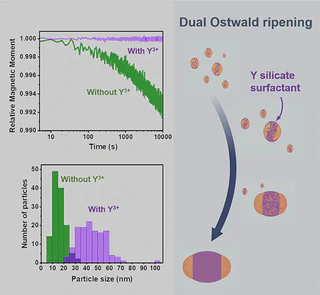
The functional properties of nanocrystals can be finely tuned through controlled morphology and size. However, this can be challenging for metastable nanostructures that require harsh synthesis conditions, such as high temperatures. Here, we present a method for preparing large ε-Fe2O3 nanorods that are not affected by magnetic relaxation. This study presents a novel growth mechanism in which high-aspect-ratio rods evolve from spherical ε-Fe2O3 particles in a silica matrix containing Y3+. With the presence of Y3+, the glassy matrix undergoes a metastable binodal decomposition yielding the formation of nanodroplets of a Y-rich silicate of composition ∼Y2Si2O7. This Y silicate selectively coats the ε-Fe2O3 planes perpendicular to the rod axis along the [100] direction but is not observed in the rod apexes. Structural optimizations and energy calculations of different crystal faces of ε-Fe2O3 in contact with Y2Si2O7 obtained using machine-learning force fields provide an atomistic interpretation of these observations: the affinity of Y with the oxygen atoms exposed at ε-Fe2O3 surfaces explains the preferential capping of ε-Fe2O3 surfaces that present a large density of oxygen atoms and its absence in surfaces such as (100), where this density is significantly lower. The presence or absence of the silicate capping layer results in different surface energies and/or mass transfer coefficients across the interface, originating two independent Ostwald ripening processes, which drive the high aspect ratio growth. By using La3+ instead of Y3+, ε-Fe2O3 rods with even larger aspect ratios are obtained. Notably, this synthetic approach counteracts the progressive diminution of the average nanoparticle size observed in ε-(Fe1–xCrx)2O3 upon Cr3+ addition, enabling to elucidate the effect of this substitution on the intrinsic magnetic anisotropy and the anisotropy fields that determine the high-frequency ferromagnetic resonances of this phase.
Type
Publication
Journal of the American Chemical Society
I was able to collaborate in this work providing my theoretical knowledge on MLIPs to a group of experimentalists at ICMAB. My knowledge was used to provide a theoretical ground to justify the experimental results in the paper.

Authors
Sergi Ortiz Ropero
(he/him)
Physics & Chemistry BSc graduate
Sergi Ortiz is a junior researcher and a prospective master’s student with special interest in Theoretical Chemistry and Computational Modeling. Honored with an excellence award, the two BScs in Physics and Chemistry have allowed him to pursue research in atomistic modeling, including the study of enzymatic systems at UAB and the study of the physical adequacy of Machine Learning Interatomic Potentials at ICMAB. With a published paper at JACS, he is now focusing on learning Japanese before venturing out further in his scientific career.