Beyond benchmarks: Importance of the physical adequacy in Machine Learning Interatomic Potentials

Sergi Ortiz Ropero
Abstract
Important areas such as material design, drug discovery and catalysis rely on modeling the system as set of interacting atoms. Knowledge of these interactions is crucial to correctly describe the system, but often requires time-consuming calculations. This work focuses on machine learning interatomic potentials (MLIPs), a novel approach to atomistic modeling in which, rather than performing time-consuming quantum mechanical calculations to obtain the energy and forces of a given set of atomic positions, a ML model is trained on quantum mechanical results to predict these properties solely based on the atomic arrangement. In order to be proven useful as physical models, these should capture the basic physics of any system, as well as the `rules’ of quantum mechanics to successfully describe atomic interactions. However, as these are not fundamentally physical models, it is not clear what basic aspects regarding symmetry, invariance and atomic interactions the models have learnt or \textitunderstood.
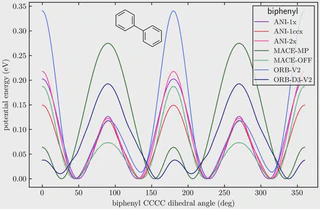
To assess the physical adequacy of the models, a series of tests have been conducted to evaluate their translational and rotational invariance, energy and linear/angular momentum conservation, as well as the description of bonds, angles and dihedrals.
While the majority of the models have been found to be physically adequate, some of them presented significant flaws regarding rotational invariance and bond descriptions, which will affect their applicability in real-world scenarios.
Type
This work is driven by the results of my final BSc thesis of Physics.
Note
This document is a work in progress and has not yet reached the ‘preprint’ status.
Machine Learning Interatomic Potentials
Atomistic Modeling
Machine Learning Force Field
Computational Chemistry

Authors
Sergi Ortiz Ropero
(he/him)
Physics & Chemistry BSc graduate
Sergi Ortiz is a junior researcher and a prospective master’s student with special interest in Theoretical Chemistry and Computational Modeling. Honored with an excellence award, the two BScs in Physics and Chemistry have allowed him to pursue research in atomistic modeling, including the study of enzymatic systems at UAB and the study of the physical adequacy of Machine Learning Interatomic Potentials at ICMAB. With a published paper at JACS, he is now focusing on learning Japanese before venturing out further in his scientific career.